I Own a Boat But I'm Not Confident Docking It. Now What?

The Secret Nobody Talks About at the Marina
There's a moment every boat owner knows. You've had a perfect day on the water — the kind of day that reminds you exactly why you bought the boat. The sun's going down, everyone's relaxed, and then you round the corner into the marina and your stomach tightens.
It's docking time.
Wind is blowing across the fairway. There are boats on both sides of your slip. Your passengers have gone quiet because they can tell you're tense. And somewhere on the dock, at least one person is watching.
If this sounds like you, here's the first thing you need to know: you're not alone, and you're not bad at boating. Docking anxiety is the single most common reason boat owners avoid taking their boats out. Not engine trouble. Not cost. Not weather. Docking.
Why Docking Is Genuinely Hard
Unlike a car, a boat doesn't have brakes. It doesn't respond instantly to steering input. It's affected by wind and current in ways that change minute to minute. And in South Florida specifically, you're dealing with tidal current in the Intracoastal, afternoon winds that pick up right when you're heading back in, and marinas designed when boats were half the size they are now.
Docking a 35-foot boat in a tight slip with a crosswind is a legitimate skill. The people who make it look easy have done it a thousand times. The fact that it stresses you out doesn't mean you're incompetent — it means you're aware of what can go wrong, which is actually the sign of a responsible operator.
Practical Tips That Actually Help
Slow Down — Then Slow Down More
The number one docking mistake is coming in too fast. When you're nervous, your instinct is to get it over with quickly. Fight that instinct. In boat handling, slow is professional. Barely above idle. You can always add a burst of power to correct your angle, but you can't take back momentum when you're about to hit the dock.
Use the Wind and Current Instead of Fighting Them
Before you commit to your approach, stop for a moment and assess. Which way is the wind blowing? Which way is the current pushing you? If the wind is pushing you toward the dock, you barely need to use the engine — let it do the work. If it's pushing you away, you'll need a steeper angle and more power. Understanding what the elements are doing before you start your approach changes everything.
Learn to Use Spring Lines
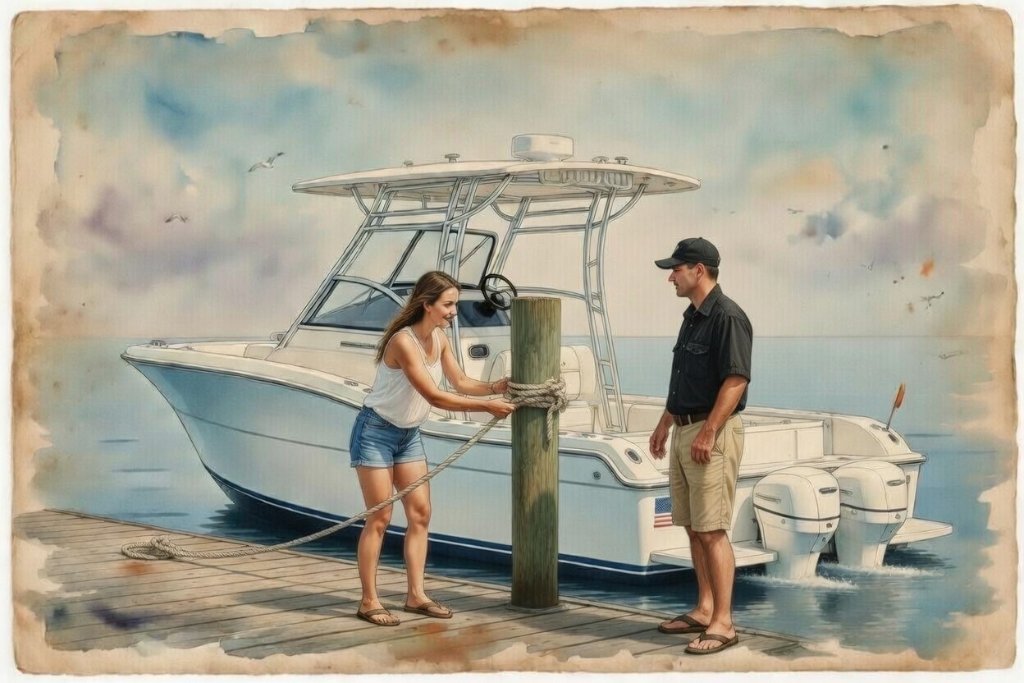
A spring line is a dock line run from your boat's midship cleat to a piling or dock cleat at an angle. Once your spring line is secured, you can use gentle forward or reverse throttle against it to walk the boat sideways into the slip. This is how professionals dock in tight spaces, and it's one of the most underused techniques among recreational boaters.
There's No Shame in the Go-Around
If your approach doesn't feel right — abort it. Power out, circle around, and try again. Every captain in the world has done this. The mark of a good operator isn't nailing it on the first try every time. It's recognizing when the approach isn't working and having the confidence to reset. Nobody at the marina is judging you for a go-around. They'll judge you a lot more for plowing into the dock.
Practice When the Stakes Are Low
Don't make your annual Fourth of July trip with twelve guests aboard your docking practice session. Go out on a calm Tuesday morning when the marina is empty. Practice approaching your slip from different angles. Get comfortable with your boat's handling characteristics at low speed — how it responds to reverse, how much it kicks to port or starboard, how quickly the bow blows in the wind.
The Confidence Shortcut: Learn From a Captain
Here's something most people don't think about: you can hire a captain specifically to teach you how to handle your boat. Not a generic boating course at a classroom — an actual session on your actual vessel, in your actual slip, with a licensed captain riding along.
Captain Club offers training trips designed for exactly this. A captain who knows your type of vessel and your local waterways works with you one-on-one. They'll teach you docking techniques specific to your slip, help you understand how your boat handles in different conditions, and build your confidence so that coming home at the end of the day feels as good as heading out.
Most owners find that just two or three sessions make a dramatic difference. You're not learning theory — you're building muscle memory on the boat you actually drive.
The Other Option: Just Let Someone Else Handle It
And if docking never becomes your thing? That's fine too. Plenty of Captain Club members book a captain specifically because they love being on the water but don't love the operational side. There's no rule that says you have to be the one behind the wheel to enjoy your own boat.
Think of it this way: you own a home, but you probably don't do your own plumbing. You own a car, but you don't change your own transmission fluid. Owning something and operating it are two different things. The point of the boat is to be on the water with people you care about. If hiring a captain gets you there more often, that's not a compromise — it's a smart move.
Stop Letting the Last Five Minutes Ruin the Day
Docking takes five minutes out of a four-hour trip. Don't let those five minutes keep you tied to the dock all season. Whether you invest in improving your skills, hire a captain to handle it, or some combination of both — the goal is the same: get on the water more.
Your boat is waiting. The sandbar is out there. The sunset isn't going to watch itself. Figure out the docking piece — one way or another — and get back to the reason you bought the boat in the first place.